The Mobile Grooming Pricing Playbook 🏷️
How to Set Prices, Protect Your Margins, and Grow Profitably
Happy Friday Daily Groomers!
Last week, we hosted our Pricing for Profit workshop with Chris Elias, co-founder & CEO of DapperTails.
Chris started his mobile grooming business with one van in 2017, grew it to 13 vans in four years, and has since helped build DapperTails into a 52-van franchise system across the country.
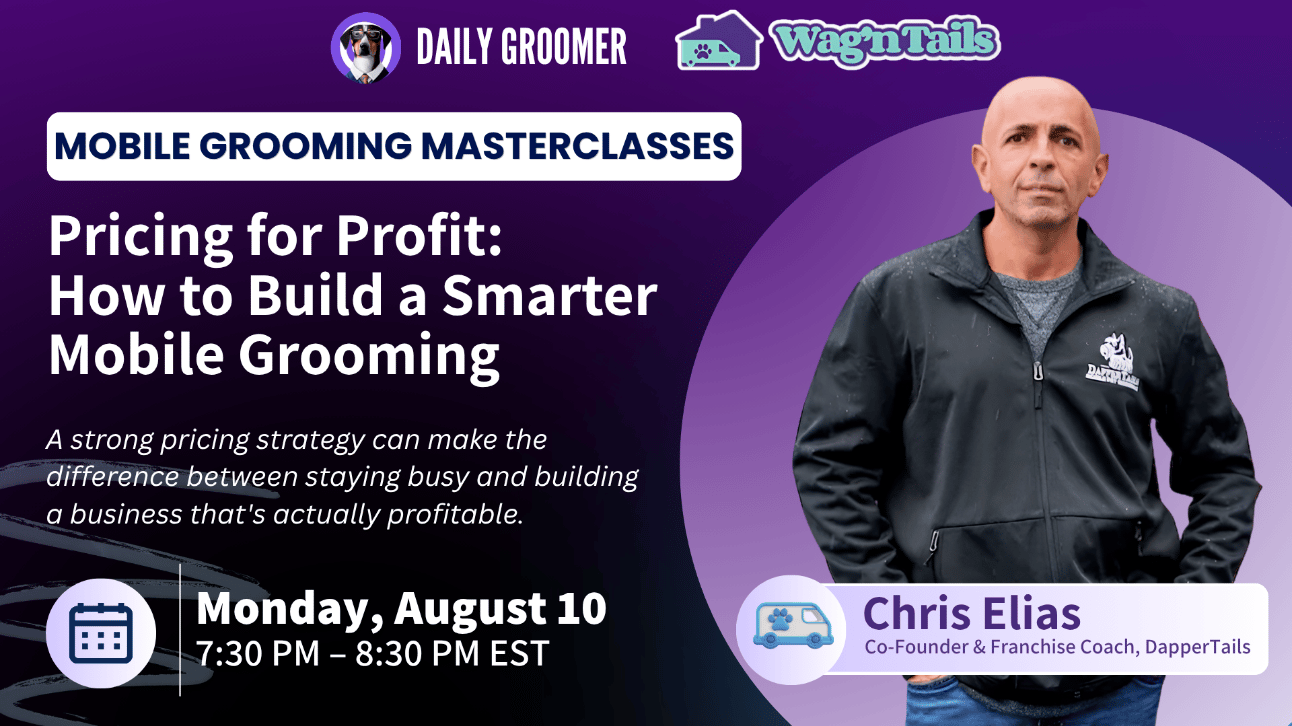
We spent nearly an hour talking about one thing:
Pricing.
And Chris's biggest message was pretty simple:
Stop pricing your business based on what your competitors charge.
Here's what stood out.
1. Start with YOUR costs — not your competitors
One of the biggest mistakes Chris sees mobile groomers make is calling competitors, figuring out what everyone else charges, and then trying to come in around the same price.
The problem?
You have no idea if they're actually making money.
Instead, build your pricing around what it actually costs to operate your business.
Chris's rough monthly estimates for a mobile grooming van included:
- Gas: $200–$300
- Insurance: ~$500
- Supplies: ~$200
- Maintenance reserve: ~$200
- Phone + software: ~$200
- Van payment: often $2,300–$2,600+
- Plus payroll if you're paying a groomer
For a financed van, he estimated total operating expenses can easily land around $3,500–$4,500+ per month before considering what you actually want to earn.
And Chris recommends building another ~20% buffer into expenses for the stuff nobody plans for: broken dryers, generators, repairs, accidents and downtime.
The goal isn't to make enough to survive a normal month. Your pricing needs to survive a bad month too.
2. Figure out your cost per dog
Chris walked through a really simple example.
Let's say:
Monthly expenses = $5,000
You groom:
5 dogs/day × 5 days/week × 4 weeks = 100 dogs/month
That means:
$5,000 ÷ 100 dogs = $50 cost per dog
But here's the important part:
$50 isn't what you should charge. It's your break-even point.
You haven't paid yourself yet.
Chris used this to reverse engineer what your average ticket actually needs to be. In that example, he suggested thinking closer to a $125 average ticket per pet rather than simply adding a few dollars onto your $50 break-even cost.
3. Don't confuse your paycheck with your profit
This was one of my favorite points from the Q&A.
If you're an owner-operator, you're doing two jobs:
You're the groomer.
And you're the business owner.
Chris believes you should pay yourself what you'd reasonably earn as a groomer and still have money left over as profit in the business.
If you pay yourself and there's nothing left at the end of the month, you don't necessarily have a profitable business.
You may have created yourself a job.
4. Being fully booked is a pricing signal
Chris had a great rule of thumb from his Long Island business:
If he couldn't get a new customer onto the schedule within about a week, he had a capacity problem.
At that point, you have two choices:
Increase capacity or increase prices.
If your goal is growth, maybe that means adding another van.
If you want to stay a one-van operation, it may mean raising prices and serving fewer, higher-value clients.
But Chris made another important point:
Don't scale an unprofitable van.
Your first van should generate the money needed to help fund van #2. If you have to keep going back into your personal savings to expand, revisit the economics of van #1 first.
5. Expect to lose some customers when you raise prices
Chris shared that DapperTails has repeatedly raised prices over the years.
And yes...
Some customers left.
He estimated that around 90% stayed through some of their increases.
His point wasn't that you'll never lose customers.
It was that losing some price-sensitive customers isn't necessarily a bad thing when there's another customer willing to pay your new rate.
The bigger lesson:
You need confidence when raising prices.
And when possible, Chris prefers communicating increases face-to-face or over the phone, rather than dropping a generic price-increase email into everyone's inbox.
6. Breed + weight is only the starting point
Chris recommends starting your pricing structure around breed and weight, but the final price should also account for:
- Time
- Coat condition
- Behavior
- Grooming frequency
- Owner expectations
A Golden groomed every four weeks isn't necessarily the same job as the same Golden groomed every 12 weeks with a neglected coat.
DapperTails typically gives customers an estimate within roughly a $20 range, then allows the groomer to confirm the final price after seeing the dog.
7. Simpler packages can make pricing easier
Instead of building dozens of little add-ons, Chris prefers a more all-inclusive premium service.
Things like nail grinding, teeth brushing, premium shampoo, conditioner, bath, blowout and brush-out are generally included rather than itemized individually.
And when someone asks to remove one small part of the service?
That doesn't necessarily mean the price needs to drop.
You're still driving to the house, getting the dog into the van and performing the majority of the appointment.
8. Recurring clients are incredibly valuable
Chris wants clients grooming as frequently as possible.
Why?
Predictable recurring customers fill your calendar, are easier to service, and create more predictable revenue.
He even discussed experimenting with discounts tied to increased frequency — four-week, three-week, two-week or even weekly schedules — because a slightly lower ticket can still be more valuable when the customer comes significantly more often.
9. Don't be afraid of premiums and service charges
DapperTails uses a $10 service charge to help absorb fluctuating expenses like gas, insurance and unexpected vehicle costs instead of constantly changing base grooming prices.
Chris also talked about charging premiums for high-demand appointments.
Early in his business, they didn't want to work Sundays, so they added a $40 Sunday premium assuming customers wouldn't pay it.
They did.
Suddenly, working Sunday made enough additional money that taking another day off during the week made sense.
The lesson wasn't necessarily "charge $40 on Sundays."
It was:
Your most valuable appointment slots don't always have to cost the same as your least valuable ones.
10. Mobile means the trip itself has value
One of the final Q&A questions was about standalone services like nail trims.
Chris's rule:
$100 minimum to pull up to a house.
Even if the actual service only takes a few minutes, you're still driving there, parking, getting the dog into the van, performing the service and giving up a calendar slot that could have been used for a full groom.
That's the part mobile groomers sometimes forget to price in.
The big takeaway
The theme Chris kept returning to was simple:
Price the business you actually want to build.
Not your competitor's business.
Not the cheapest business in town.
And not a business that leaves you fully booked but barely making money.
Know your costs. Pay yourself for grooming. Leave profit in the business. Build a buffer for the unexpected. And when demand exceeds your capacity, either raise your prices or increase your capacity.
👇 Watch the full Pricing for Profit workshop + download the complete resource guide here.
📘 Download the Mobile Grooming Giveaway Guide
Want to join our next Mobile Grooming Masterclass?
You’ve got your pricing dialed in. Now let’s fill the calendar.
On August 31, we’re back with Build a Brand That Books, a free masterclass all about marketing your mobile grooming business and winning more customers.
We’ll cover what actually works for mobile groomers: building a brand people remember, getting found locally, turning social media into bookings, generating referrals, and keeping your calendar full.
If you can't make it live on Monday, everyone who RSVPs will receive the recording afterward.
Hope to see you there!
Alex